
A homework diary is a familiar part of school life, yet it often goes overlooked when schools think about organisation and communication. With digital platforms now widely used, it is easy to question whether a physical homework diary still has a place.
In practice, many schools continue to rely on them because they offer something simple and consistent. A homework diary gives students a clear place to record tasks, track deadlines and stay organised across the week. It also provides a direct link between school and home, helping teachers, students and parents stay on the same page.
This guide looks at how homework diaries are used in real classrooms, the benefits they bring and why they remain relevant across UK schools.
Quick Answer: What Is A Homework Diary?
A homework diary is a structured school diary used by students to record homework tasks, deadlines, reminders, notes and key school information. It helps students organise their work while giving teachers and parents a consistent place to check what has been set.
| Homework diary feature | Why it matters |
|---|---|
| Homework recording space | Helps students write down tasks clearly before leaving the lesson. |
| Deadline tracking | Makes it easier to see what is due soon and what can be planned ahead. |
| School-home communication | Gives parents, carers and teachers a shared place for reminders and notes. |
| Consistent school routine | Supports the same homework recording process across classes, forms and year groups. |
What Is A Homework Diary?
A homework diary is a structured book used by students to record homework, deadlines and key school information.
It is usually organised into daily or weekly pages, with space to write down tasks set in lessons. Many also include sections for notes, communication between school and home, and guidance to support study and organisation.
Unlike a general notebook, a school homework diary follows a clear format that aligns with the academic year and the school timetable. This makes it easier for students to build a routine and easier for teachers to check that tasks have been recorded properly.
What Is A Homework Diary Used For?
Recording Homework Tasks
Students use their homework diary to write down tasks as they are set. This creates a clear record of what needs to be completed and avoids relying on memory at the end of a busy day.
In a typical lesson, a teacher will allow a few minutes for students to record homework before they leave. This simple routine helps reduce confusion later on.
Tracking Deadlines
Homework diaries provide a visible timeline for tasks. Students can see what is due the next day, later in the week or further ahead.
For example, a Year 9 student working on multiple subjects can quickly check their diary and prioritise what needs to be done first.
Communicating With Parents
Many schools use homework diaries as a communication tool. Teachers may add notes, reminders or feedback, while parents can sign or respond where needed.
This creates a consistent link between school and home without relying on emails or apps that may be missed.
Supporting Classroom Routine
Homework diaries often form part of the daily routine. Teachers may check them at the start or end of lessons to ensure tasks are recorded and understood.
Over time, this builds a habit that supports organisation across all subjects.
Homework Diary Vs Student Planner: What Is The Difference?
The terms homework diary and student planner are often used together, but they can describe slightly different products.
A homework diary is usually focused on recording homework, deadlines, notes and communication between school and home. A student planner can be broader, with extra space for targets, timetables, school information, study support, reading logs or wider personal organisation.
| Choose a homework diary if… | Choose a student planner if… |
|---|---|
| You mainly need students to record homework and deadlines. | You want a broader school organisation tool. |
| You need a simple, low-cost format for whole year groups. | You want more space for targets, timetables, notes or school information. |
| You are buying for younger secondary students building homework habits. | You are reviewing student organisation more broadly across the school. |
If you are comparing options, view our wider range of Student Planners & Diaries.
Key Benefits Of Using A Homework Diary
Improves Student Organisation
A homework diary gives students a clear structure for managing their workload. Instead of juggling loose sheets or trying to remember tasks, everything is written in one place.
In practice, this means fewer last minute searches for homework details and a better sense of control over the week.
Encourages Responsibility
Writing down homework encourages students to take ownership of their work. The act of recording tasks makes expectations clearer and helps build independent study habits.
Teachers often find that students who use their diary consistently are more aware of what is required of them.
Reduces Missed Homework
Missed homework is often the result of confusion rather than lack of effort. A structured homework diary reduces this risk by providing a reliable record.
When every student records tasks in the same format, it becomes easier for teachers to check and for students to follow through.
Strengthens Parent And Teacher Communication
Homework diaries create a simple and effective way for parents to stay informed. A quick check at home shows what has been set and when it is due.
This can lead to more consistent support, particularly for younger students who benefit from guidance outside the classroom.
Creates Consistency Across the School
When a school uses the same homework diary format, expectations become clearer for everyone. Students understand where to record work and teachers know where to look.
This consistency supports behaviour management and reduces time spent repeating instructions.
Why Homework Diaries Still Matter In A Digital World
Digital tools are now part of everyday school life. Many schools use online platforms to set homework and share resources. Even so, homework diaries continue to play an important role.
Not all students engage consistently with digital systems. Some forget to check platforms, while others are distracted by notifications when using devices. A physical homework diary avoids these issues by keeping everything visible and accessible.
There is also no reliance on internet access or devices. Every student has the same tool, which creates a level of consistency across the classroom.
From a teacher’s perspective, checking a homework diary is quick and straightforward. A glance at a page is often enough to confirm whether work has been recorded. This can be more efficient than navigating digital systems during lesson time.
How Homework Diaries Are Used In Schools
In many schools, homework diaries are built into the daily routine.
At the end of a lesson, teachers allow time for students to write down homework. This ensures tasks are recorded accurately. Some schools include a short check at the start of the next lesson to confirm completion.
Weekly routines are also common. Tutors may review diaries during form time, checking for organisation and parent signatures. This provides an opportunity to address any issues early.
Parents often play a role as well. A simple signature at the end of the week confirms that homework has been seen and supports accountability.
Some diaries also include space for behaviour notes or general communication, allowing teachers to share quick updates without needing separate systems.
| School routine | How the diary supports it |
|---|---|
| Lesson endings | Students write homework down before leaving the classroom. |
| Form time checks | Tutors can quickly check organisation, deadlines and signatures. |
| Parent/carer review | Home can see what has been set and support students with routines. |
| School-wide consistency | Everyone uses the same format for homework recording and communication. |
What Makes A Good Homework Diary?
A good homework diary should be clear and easy to use. Pages need to provide enough space for writing without becoming cluttered.
A structured layout helps students understand where to record tasks and how to organise their week. Sections for notes or communication add value by supporting interaction between school and home.
Durability is also important. Homework diaries are used every day and need to withstand being carried between lessons and home.
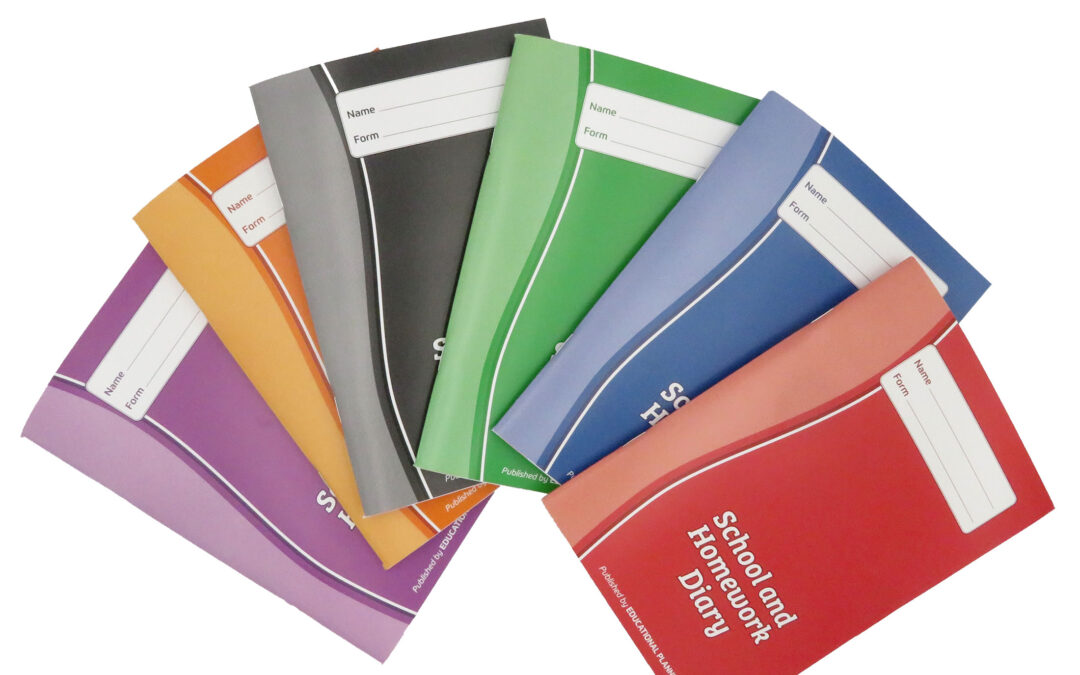
At Educational Planning Books, our homework diaries have been developed with these practical needs in mind. Our best-selling School and Homework Diary has been used for over 30 years and is designed to support students in Years 7 to 9. It offers more space for recording homework than many standard diaries, along with a strong, hardwearing format.
Choosing The Right Homework Diary For Your School
Selecting the right homework diary depends on how your school operates.
Secondary schools often require more space for multiple subjects and detailed homework tracking. Simpler layouts may be more suitable for younger year groups, where clarity is key.
Personalisation can also be useful. Adding a school name, crest or specific pages allows the diary to reflect your school’s approach and expectations.
Other student planning tools also play an important role. My Reading Record and My Reading Journal support literacy development and encourage regular reflection.
If you are reviewing student organisation tools more broadly, you may also find it helpful to explore our wider range of student planners and diaries.
School Homework Diary Buying Considerations
For schools, choosing a homework diary is usually about more than choosing a single product. It needs to work across year groups, fit your routines and be practical for bulk ordering.
| Consideration | What to check |
|---|---|
| Year groups | Decide whether the diary is needed for Years 7, 8 and 9, a single year group or wider student use. |
| Homework space | Make sure there is enough room for students to record tasks clearly across several subjects. |
| School communication | Consider how teachers, tutors, parents and carers will use the diary for notes, checks or signatures. |
| Durability | Choose a diary that can handle daily movement between school, classrooms and home. |
| Customisation | Check whether school name, crest or specific pages can be added. |
| Bulk ordering | Confirm quantities, delivery timing and ordering process before the start of the academic year. |
EdPlan School And Homework Diary
The School and Homework Diary from Educational Planning Books is designed for schools that need a practical, budget-priced diary for students.
It is especially suitable for Years 7, 8 and 9, where students are often building stronger organisation habits, managing different subjects and learning to take more responsibility for homework and deadlines.
Main features
- A5 size
- 96 stitched pages
- Strong covers
- More space to record homework assignments than other homework diaries
- Low price, offering good value for school orders
- Can be overprinted with the school name and crest
- Available in Mixed, Blue, Red, Purple, Green, Orange and Charcoal colour options
Schools can order online or contact the team if they need support with larger orders, colours, overprinting or delivery planning.
Keeping Students On Track
A homework diary remains a simple but effective tool for supporting organisation in schools. It helps students keep track of their work, encourages responsibility and creates a clear link between school and home.
While digital platforms continue to develop, the value of a consistent, easy-to-use system should not be overlooked. In many classrooms, a well-designed homework diary still plays a key role in keeping students on track.
Explore Your Options
If you are considering introducing or updating homework diaries in your school, you can explore our Student Planners & Diaries range or get in touch to discuss custom options.
Learn how to order today or give us a call on 01433 651010, email us at sales@edplanbooks.com, or fill in our online contact form.
Homework Diary FAQs
What is a homework diary?
A homework diary is a structured school diary used by students to record homework tasks, deadlines, reminders, notes and key school information.
What is a homework diary used for?
A homework diary is used to record homework, track deadlines, support organisation and provide a simple communication link between school and home.
Do schools still use homework diaries?
Yes. Many schools still use homework diaries because they provide a consistent, easy-to-check system for recording homework and supporting student organisation.
What is the difference between a homework diary and a student planner?
A homework diary usually focuses on homework tasks, deadlines and communication. A student planner can be broader, with extra space for targets, timetables, school information, study support and wider organisation.
What year groups are homework diaries useful for?
Homework diaries are often useful for younger secondary students, especially Years 7, 8 and 9, as they help build routines around homework, deadlines and independent organisation.
Can homework diaries be used for parent signatures?
Yes. Many schools use homework diaries for parent or carer signatures as part of a weekly routine, helping confirm that homework and school notes have been seen at home.
Can school homework diaries be personalised?
Yes. Some school homework diaries can be personalised or overprinted with a school name and crest, depending on the product and ordering requirements.
Where can schools order homework diaries?
Schools can order the School and Homework Diary online, call 01433 651010, email sales@edplanbooks.com, or use the contact form.